A Quick Word Before We Begin
Every enterprise sales leader in Canada eventually hits the same wall. Reps are busy, pipelines look fine on paper, and quarterly numbers still fall short. The gap usually isn’t effort. It’s method. A national sales force selling into banks in Toronto, energy firms in Calgary, and manufacturers in Montreal needs a shared playbook, consistent coaching, and a way to measure whether training actually changed behaviour on calls.
That’s what separates a corporate sales training program from a one-day motivational seminar. The right program gives sales managers a common language, gives reps a repeatable process for qualifying and closing complex, multi-stakeholder deals, and gives the C-suite a way to tie the spend to pipeline coverage and win rate. Canadian buyers face their own set of pressures too: bilingual markets, a compliance-heavy financial services sector, cross-border selling into the United States, and long procurement cycles inside public sector and enterprise accounts.
This guide breaks down ten of the most established enterprise sales training providers working with Canadian companies today, what each one is built for, what it costs, and how to choose between them. Pearl Lemon Sales put this list together as a reference for founders, VPs of sales, and revenue leaders comparing options before they commit budget.
The Programs Covered in This Guide
- Sandler Training
- Richardson & Challenger (formerly Richardson Sales Performance)
- RAIN Group
- Miller Heiman Group (Korn Ferry Sell)
- Force Management
- DoubleDigit Sales
- TrainingFolks
- Professional Sales Academy
- Corporate Visions
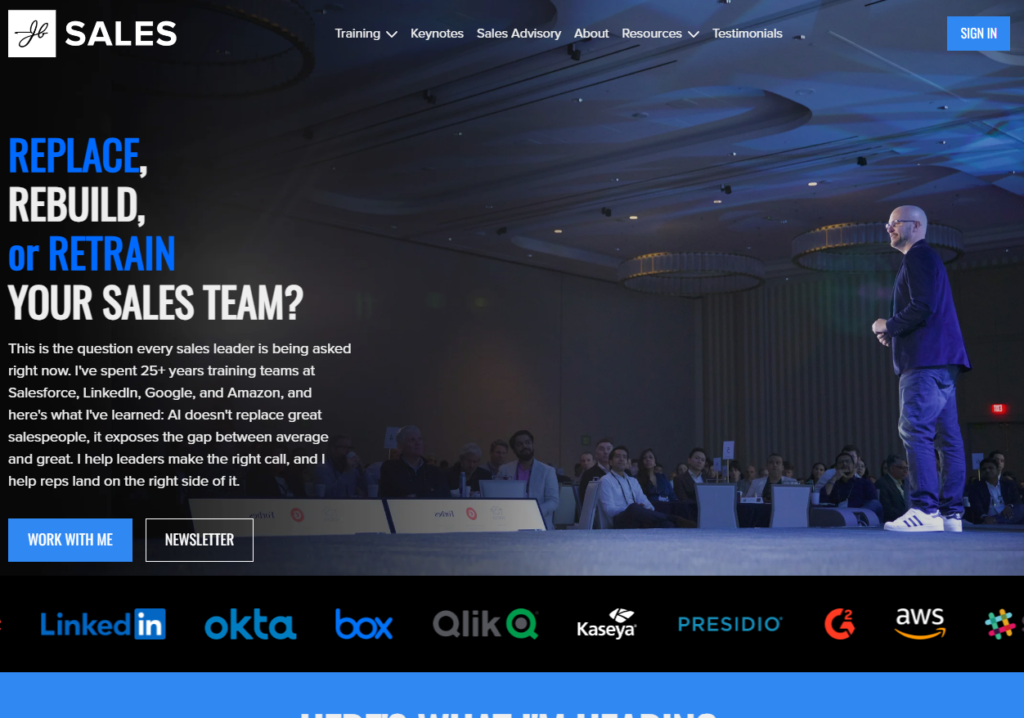
- JBarrows Sales Training
What Is an Enterprise Sales Training Program
An enterprise sales training program is a structured course of instruction, coaching, and reinforcement built for organizations selling complex products or services to large accounts with several decision makers. Unlike a generic sales seminar, it typically includes a documented methodology (a repeatable set of steps and questions reps follow through a deal), manager coaching so the skills stick after the workshop ends, and some form of measurement so the business can see whether pipeline quality, deal size, or win rate improved.
Most providers on this list offer their content through several formats: in-person workshops, virtual instructor-led sessions, on-demand e-learning, and one-to-one or small-group coaching. Larger firms selling into national or global accounts usually need a mix of all three, since a single format rarely sticks on its own.
What Qualifies as a Good Program
Not every course marketed as “enterprise sales training” is built for enterprise selling. Before you sign a contract, check the provider against these markers:
- A documented methodology. The provider should be able to name and explain their framework in plain terms, not just describe a list of soft skills.
- Manager reinforcement, not just rep training. Skills fade within weeks without a manager coaching cadence built into the program.
- Experience with long, multi-stakeholder sales cycles. This matters far more for enterprise selling than general consumer or SMB sales training.
- A track record with companies of a similar size and industry to yours. A firm that mostly trains small retail teams is a poor fit for a 200-person enterprise software sales floor.
- Clear reporting on outcomes. You should be able to see how the program connects to pipeline coverage, average deal size, or win rate, not just attendance numbers.
- Flexible delivery for a Canadian, often bilingual, workforce spread across time zones.
Program Comparison at a Glance
| Program | Founded | Founder(s) | Best Suited For | Delivery Formats |
| Sandler Training | 1967 | David Sandler | Mid-market and enterprise teams wanting a full behavioural system | In-person, virtual, e-learning, franchise centres |
| Richardson & Challenger | 1978 | Linda Richardson | Large, complex B2B sales organizations | Instructor-led, virtual, coaching platform |
| RAIN Group | 2002 | Mike Schultz and John Doerr | Consultative selling teams focused on buyer-informed conversations | In-person, virtual, self-study, Toronto office |
| Miller Heiman Group (Korn Ferry Sell) | Late 1970s | Robert Miller and Stephen Heiman | Multi-stakeholder, long-cycle enterprise deals | Workshops, coaching, digital platform |
| Force Management | 2003 | John Kaplan and Grant Wilson | High-growth technology and software sales teams | Workshops, MEDDICC coaching, Ascender platform |
| DoubleDigit Sales | 2000 | Founding team in Toronto | Canadian enterprise teams wanting local delivery | Virtual instructor-led, custom workshops |
| TrainingFolks | 1997 | Canadian founding team | Companies needing custom curriculum design | Contract facilitators, custom programs |
| Professional Sales Academy | Founded by Shane Gibson and Bill Gibson | Shane Gibson and Bill Gibson | SMB to mid-market Canadian teams and social selling | Online certificate, live workshops |
| Corporate Visions | 1993 | Founding team in California | Marketing and sales message alignment for enterprise accounts | Workshops, virtual, content library |
| JBarrows Sales Training | 2011 | John Barrows | SaaS and technology sales development teams | Live workshops, on-demand video library |
The Best Enterprise Sales Training Programs in Canada
1. Sandler Training
Program Snapshot
| Detail | Information |
| Founder | David Sandler |
| Year Established | 1967 |
| Headquarters | Owings Mills, Maryland, with a franchise location serving Toronto and the wider Canadian market |
| Team Size | 230+ training centres across 30+ countries |
| Pearl Lemon Sales Editorial Rating | ★★★★☆ (4.4/5) |
Sandler is one of the oldest names in the sales training industry, and its Toronto centre gives Canadian companies direct access to a system that has been refined across five decades of client work. The Sandler Selling System takes reps away from pushy closing tactics and instead teaches them to qualify prospects properly before ever presenting a solution.
The Method Behind the System
Sandler organizes the sales conversation into three phases: building rapport, qualifying the opportunity against budget, decision process, and need, and then closing without pressure. Reps learn to act more like consultants than order takers, which suits industries where trust and long-term relationships matter most.
Key Feature: Behavioural Reinforcement
Sandler doesn’t stop at a single workshop. Its franchise model means clients get ongoing weekly reinforcement sessions, which is a large part of why the system tends to stick with sales teams long after the initial training.
Key Feature: Attitude, Behaviour, Technique Model
Sandler’s philosophy rests on three pillars: mindset, habits, and skill. Training addresses all three, rather than treating sales performance as a purely technical problem.
Key Feature: Local Franchise Delivery
Because Sandler operates through local franchise owners, Canadian businesses can work with a trainer who understands their specific market and industry rather than a purely head-office program shipped in from another country.
Pricing for Sandler Training
| Format | Typical Investment | Notes |
| Public workshop seat | Roughly $1,500 to $3,000 CAD per participant | Varies by franchise location and course length |
| Team or corporate program | Custom quote, generally $15,000 to $100,000+ CAD | Based on team size, number of sessions, and coaching cadence |
| Ongoing reinforcement | Monthly retainer, quoted per engagement | Weekly or biweekly coaching sessions |
Exact figures depend on the franchise location handling your account and your team size, so a direct consultation is the only way to get a firm number.
Pros and Cons
| Pros | Cons |
| Long operating history with a well-documented methodology | Quality can vary between franchise locations |
| Strong focus on reinforcement, not just a single event | Terminology and role-play format take some getting used to |
| Local delivery through a Canadian-based centre | Full behavioural change requires a longer commitment than a single workshop |
Best Use Case
Sandler suits mid-market and enterprise teams that want a full behavioural system rather than a set of standalone tactics, and that are prepared to commit to ongoing coaching rather than a single event.
2. Richardson & Challenger
Program Snapshot
| Detail | Information |
| Founder | Linda Richardson |
| Year Established | 1978 |
| Headquarters | Philadelphia, Pennsylvania, with clients across Canada’s financial services and technology sectors |
| Team Size | 150+ employees, now combined with the Challenger organization |
| Pearl Lemon Sales Editorial Rating | ★★★★★ (4.7/5) |
Richardson built its name on consultative selling long before the term became standard vocabulary, and its recent combination with Challenger, the firm behind the well-known Challenger Sale methodology, gives clients access to two respected frameworks under one roof.
The Method Behind the System
Richardson’s approach centres on structured conversations that uncover a buyer’s underlying priorities rather than surface-level requirements. The Challenger side adds a teach, tailor, and take control model designed for reps selling into informed, skeptical buying committees, which is common across Canadian banking, insurance, and enterprise technology accounts.
Key Feature: Combined Methodology Library
Clients can now mix consultative selling skills with Challenger’s commercial teaching approach depending on the deal type, giving sales leaders more than one lever to pull.
Key Feature: Digital Coaching Platform
Richardson pairs its workshops with a coaching and reinforcement platform, so managers can track skill adoption after the training ends rather than guessing whether it worked.
Key Feature: Long-Standing Industry Recognition
Richardson has appeared on Training Industry’s list of top sales training providers for close to two decades, which reflects consistent delivery quality across a large client base.
Pricing for Richardson & Challenger
| Format | Typical Investment | Notes |
| Public or virtual course | Around $1,800 to $3,500 CAD per seat | Course length and certification level affect the final rate |
| Enterprise rollout | Custom quote, often $50,000 to $300,000+ CAD | Priced by number of sales teams, regions, and coaching hours |
| Platform access and reinforcement | Annual licence, quoted per user | Includes digital coaching tools |
Pros and Cons
| Pros | Cons |
| Two well-regarded methodologies available under one provider | Enterprise rollouts require a longer planning cycle |
| Strong reporting through its coaching platform | Higher price point than smaller independent trainers |
| Deep experience with regulated, complex industries | Newer combined offering means some materials are still being unified |
Best Use Case
Richardson & Challenger fits large, complex B2B organizations, particularly in financial services, insurance, and enterprise technology, that need both consultative selling skills and a way to compete against status quo in committee-based buying decisions.
3. RAIN Group
Program Snapshot
| Detail | Information |
| Founders | Mike Schultz and John Doerr |
| Year Established | 2002 |
| Headquarters | Boston, Massachusetts, with a dedicated Canada practice based in Toronto |
| Team Size | 11 to 50 core staff plus a global network of facilitators |
| Pearl Lemon Sales Editorial Rating | ★★★★☆ (4.5/5) |
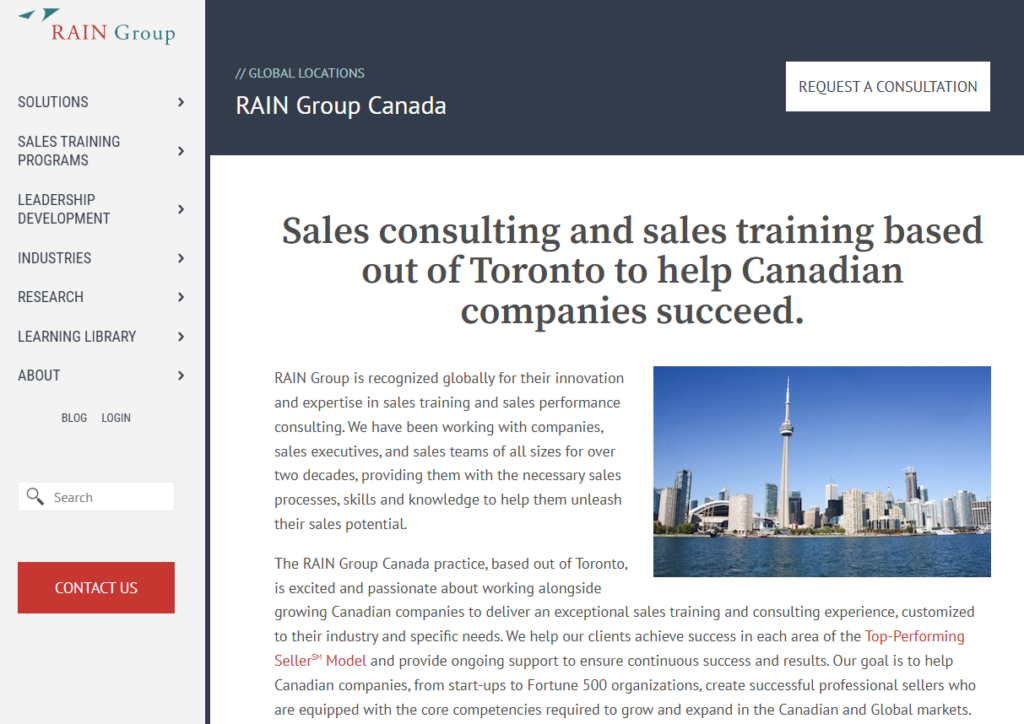
RAIN Group runs a Toronto-based practice specifically for Canadian clients, working with everything from local start-ups to Fortune 500 companies with offices across the country. Its research arm, the RAIN Group Center for Sales Research, publishes regular studies on what separates top-performing sellers from the rest, which feeds directly into its curriculum.
The Method Behind the System
RAIN Selling teaches reps to lead sales conversations that connect a buyer’s stated problem to a broader business case, rather than reacting to whatever the prospect brings up first. The company also teaches Insight Selling, an approach built around bringing new ideas to a buyer rather than simply asking about existing needs.
Key Feature: Research-Backed Curriculum
RAIN Group regularly publishes benchmark studies on prospecting, negotiation, and account growth, and updates its training content based on the findings rather than relying on decades-old material.
Key Feature: Local Canadian Practice
The Toronto office works with local industries including financial services, professional services, and manufacturing, giving Canadian clients a facilitator who understands regional buying norms.
Key Feature: Full Sales Curriculum
Beyond core selling skills, RAIN Group covers prospecting, negotiation, account growth, and sales management coaching, so a company can build a full multi-year program with one provider rather than stitching together several vendors.
Pricing for RAIN Group
| Format | Typical Investment | Notes |
| Public workshop | Roughly $1,600 to $3,200 CAD per participant | Depends on course topic and length |
| Custom corporate program | Custom quote, generally $40,000 to $250,000+ CAD | Scoped around team size, number of modules, and coaching |
| Self-Study+ digital course | Per-user licence, quoted separately | Useful for smaller teams or individual reps |
Pros and Cons
| Pros | Cons |
| Dedicated Toronto practice for Canadian clients | Full curriculum can feel broad if you only need one skill area |
| Backed by ongoing original research | Custom programs need a longer discovery phase to scope properly |
| Wide range of modules from prospecting through account growth | Higher-touch delivery may cost more than a single-topic course |
Best Use Case
RAIN Group works well for consultative selling teams that lead with new ideas rather than a fixed pitch, especially those serving financial services, professional services, or technology clients who want a Canadian point of contact backed by international research.
4. Miller Heiman Group (Korn Ferry Sell)
Program Snapshot
| Detail | Information |
| Founders | Robert Miller and Stephen Heiman |
| Year Established | Late 1970s |
| Headquarters | Originally Reno, Nevada, now operating as part of Korn Ferry with offices serving Canada |
| Team Size | Part of Korn Ferry, a global organization with thousands of employees |
| Pearl Lemon Sales Editorial Rating | ★★★★☆ (4.3/5) |
Miller Heiman built the Strategic Selling and Conceptual Selling frameworks that shaped how a generation of enterprise sales teams approach large, multi-stakeholder deals. The company is now part of Korn Ferry, which folds sales training into a much broader talent and leadership consulting practice.
The Method Behind the System
The core idea is simple to describe but hard to execute without training: map every person involved in a purchase decision, understand what each one personally needs from the outcome, and build a plan around the whole group rather than a single champion. This structured account planning approach, often associated with the Blue Sheet planning tool, remains one of the most recognized frameworks for account-based, enterprise selling.
Key Feature: Strategic Account Mapping
Reps learn to identify economic buyers, technical buyers, and user buyers within a single deal, which matters enormously in Canadian public sector and enterprise procurement processes involving several stakeholders.
Key Feature: Large Account Management Process
Beyond winning a single deal, the program teaches reps how to plan and grow existing strategic accounts over multiple years, which suits businesses with a smaller number of very large customers.
Key Feature: Integration With Korn Ferry’s Broader Talent Suite
Because Miller Heiman now sits inside Korn Ferry, clients can combine sales training with leadership development and talent assessment services from the same provider.
Pricing for Miller Heiman Group
| Format | Typical Investment | Notes |
| Public workshop | Roughly $1,800 to $3,000 CAD per seat | Course length varies |
| Enterprise account planning program | Custom quote, often $60,000 to $350,000+ CAD | Priced around number of strategic accounts covered |
| Digital platform licence | Per-user annual fee | Supports account plan tracking between sessions |
Pros and Cons
| Pros | Cons |
| Long-established framework recognized across many industries | Terminology and tools take time and repetition to use well |
| Strong fit for very large, multi-year account relationships | Best suited to genuinely complex deals, less useful for shorter sales cycles |
| Access to Korn Ferry’s wider talent development resources | Pricing sits at the higher end of the market |
Best Use Case
This program is built for enterprise teams managing long sales cycles with six or more stakeholders per deal, particularly account management teams responsible for growing a small number of very large customers.
5. Force Management
Program Snapshot
| Detail | Information |
| Founders | John Kaplan and Grant Wilson |
| Year Established | 2003 |
| Headquarters | Charlotte, North Carolina, with clients across Canadian technology and software companies |
| Team Size | Mid-sized consulting firm, doubled its staff between 2021 and 2022 |
| Pearl Lemon Sales Editorial Rating | ★★★★☆ (4.6/5) |
Force Management built its reputation working with fast-growing technology and software companies, many of them venture-backed businesses scaling their go-to-market teams quickly. Its Command of the Message and Command of the Sale programs are widely used across the enterprise software sector, including several Canadian tech companies expanding into US and global markets.
The Method Behind the System
Force Management’s programs teach reps to connect their pitch directly to a buyer’s specific business priorities, using the MEDDICC qualification framework to assess whether a deal is genuinely winnable before investing more time in it.
Key Feature: MEDDICC Qualification
Reps learn to check Metrics, Economic Buyer, Decision Criteria, Decision Process, Identify Pain, Champion, and Competition on every deal, which gives sales leaders a consistent, honest read on pipeline health.
Key Feature: Ascender Platform
Force Management built its own reinforcement platform, Ascender, so sales messaging and coaching content stay accessible to reps long after the live sessions end.
Key Feature: Message Alignment Across Teams
The program pushes sales, marketing, and customer success to use the same language when describing value to a buyer, which reduces the mixed messaging that often confuses enterprise accounts during a long sales cycle.
Pricing for Force Management
| Format | Typical Investment | Notes |
| Command of the Message workshop | Custom quote, commonly $30,000 to $80,000 CAD per cohort | Priced by group size rather than per seat |
| Full go-to-market engagement | Custom quote, often $100,000 to $400,000+ CAD | Includes messaging, qualification, and coaching |
| Ascender platform access | Per-user annual fee | Optional add-on for ongoing reinforcement |
Pros and Cons
| Pros | Cons |
| Deep experience with high-growth technology and software sales | Pricing structure favours larger cohorts over individual seats |
| MEDDICC framework gives a clear, consistent qualification standard | Less focused on non-technology industries |
| Strong track record with venture-backed and scaling companies | Full engagements require genuine organizational commitment |
Best Use Case
Force Management is a strong fit for high-growth technology and software sales teams that need a consistent qualification framework and message alignment across sales, marketing, and customer success.
6. DoubleDigit Sales

Program Snapshot
| Detail | Information |
| Founded As | Fusion Learning |
| Year Established | 2000 |
| Headquarters | Toronto, Ontario, Canada |
| Team Size | Around 28 to 30 employees, now operating under Richardson Sales Performance |
| Pearl Lemon Sales Editorial Rating | ★★★★☆ (4.2/5) |
DoubleDigit Sales built its business entirely inside Canada, working with recognizable national and multinational clients including 3M, Manulife, and Scotiabank before Richardson acquired the company in 2022. It remains one of the clearest Canadian-founded options on this list, and its blue-chip client history says a lot about the durability of its practical, no-nonsense approach to sales training.
The Method Behind the System
DoubleDigit’s programs focus on sales effectiveness and sales management skills, with a strong practical emphasis rather than heavy theory. Its Strategic Sales BluePRINT program helps teams build a documented, repeatable approach to selling that new hires can pick up quickly.
Key Feature: Canadian Client Base
Two decades of work with well-known Canadian and North American companies gives the firm a strong understanding of local buying culture and procurement norms.
Key Feature: Sales Management Coaching
Beyond training individual reps, DoubleDigit places heavy emphasis on developing sales managers, since manager coaching quality is often the single biggest factor in whether new skills actually stick.
Key Feature: Virtual Delivery Built for Scale
The company built strong virtual instructor-led training capability well before it became standard across the industry, which suits companies with sales teams spread across several Canadian provinces or time zones.
Pricing for DoubleDigit Sales
| Format | Typical Investment | Notes |
| Virtual workshop | Roughly $1,200 to $2,500 CAD per participant | Shorter modules available for smaller budgets |
| Custom sales effectiveness program | Custom quote, generally $25,000 to $150,000+ CAD | Priced around team size and number of modules |
| Manager coaching add-on | Quoted separately per cohort | Recommended alongside any rep-level training |
Pros and Cons
| Pros | Cons |
| Two decades of Canadian delivery experience | Now folded into Richardson, so its independent brand identity is shifting |
| Strong focus on sales management coaching, not just reps | Smaller company than some global alternatives |
| Practical, straightforward training style | Some legacy materials are being merged with Richardson’s library |
Best Use Case
DoubleDigit Sales suits Canadian enterprise teams that want local delivery, a track record with recognizable national clients, and a strong focus on developing sales managers alongside frontline reps.
7. TrainingFolks
Program Snapshot
| Detail | Information |
| Founded By | A Canadian founding team |
| Year Established | 1997 |
| Headquarters | Canada, with delivery capability across North America |
| Team Size | Network of contract facilitators supporting client engagements |
| Pearl Lemon Sales Editorial Rating | ★★★★☆ (4.1/5) |
TrainingFolks operates differently from most providers on this list. Rather than selling a single fixed methodology, the company builds custom corporate training programs and supplies experienced contract facilitators to deliver them, which appeals to enterprise clients who already have an internal sales playbook but need outside expertise to build or deliver it.
The Method Behind the System
TrainingFolks works as a design and delivery partner. It helps businesses turn their own sales process, product knowledge, and competitive positioning into a structured curriculum, then supplies facilitators to run the sessions in person or virtually.
Key Feature: Custom Curriculum Design
Rather than forcing a company into someone else’s framework, TrainingFolks builds programs around the client’s existing sales process, which suits businesses with a mature, well-documented approach already in place.
Key Feature: Facilitator Network
The company maintains a roster of experienced adult learning professionals who can be matched to a client’s industry and audience, which gives flexibility for large rollouts across multiple regions.
Key Feature: Nearly Three Decades of Operating History
Since 1997, TrainingFolks has built a long enough track record that it has weathered several shifts in how corporate training gets delivered, from classroom-only to fully virtual formats.
Pricing for TrainingFolks
| Format | Typical Investment | Notes |
| Facilitator day rate | Roughly $1,500 to $3,000 CAD per facilitator day | Depends on facilitator experience and travel |
| Custom curriculum design project | Custom quote, often $10,000 to $75,000+ CAD | Priced by scope and number of modules developed |
| Full program rollout | Custom quote based on team size and regions covered | Includes design, facilitation, and materials |
Pros and Cons
| Pros | Cons |
| Genuinely custom content built around your own sales process | No single proprietary methodology if you want an off-the-shelf system |
| Long operating history and a wide facilitator network | Quality depends on which facilitator is matched to your account |
| Flexible for companies with an existing internal playbook | Requires more input and time from your own team during design |
Best Use Case
TrainingFolks fits companies that already have a working sales process and need outside expertise to turn it into structured, well-facilitated training, rather than adopting someone else’s methodology from scratch.
8. Professional Sales Academy
Program Snapshot
| Detail | Information |
| Founders | Shane Gibson and Bill Gibson |
| Year Established | Founded through Knowledge Brokers International, with continued delivery today |
| Headquarters | Vancouver and Toronto, Canada, with reach into South Africa and the Middle East |
| Team Size | Small, founder-led team with an affiliate network |
| Pearl Lemon Sales Editorial Rating | ★★★☆☆ (3.9/5) |
Professional Sales Academy runs the Enterprise Sales Professional Program, accredited by Sales and Marketing Executives International, and delivers a widely used online sales certificate in partnership with Langara College. The program blends traditional B2B selling skills with a genuine focus on social selling, which many older methodologies still treat as an afterthought.
The Method Behind the System
The curriculum covers strategic planning, needs analysis, objection handling, account management, and social selling through LinkedIn and other platforms, delivered through online modules, live coaching, and a final applied sales plan that participants must complete to earn certification.
Key Feature: Accredited Certification
The Enterprise Sales Professional Program carries formal accreditation, which some Canadian employers value as evidence of a recognized standard rather than an informal course.
Key Feature: Social Selling Focus
Given how much enterprise buying now starts online, the program’s attention to LinkedIn prospecting and digital relationship building fills a gap that older, more traditional methodologies tend to overlook.
Key Feature: Flexible Online Delivery
Originally built for Vancouver and Toronto audiences, the program is now fully accessible online, which suits distributed Canadian sales teams without requiring travel.
Pricing for Professional Sales Academy
| Format | Typical Investment | Notes |
| Online certificate program | Roughly $1,000 to $2,000 CAD per participant | Self-paced with coach feedback |
| Enterprise Sales Professional Program (corporate cohort) | Custom quote, generally $15,000 to $60,000 CAD | Priced by group size |
| Keynote or single workshop | Quoted per engagement | Common add-on for kickoffs and conferences |
Pros and Cons
| Pros | Cons |
| Formal accreditation adds credibility to certification | Smaller organization than some global competitors |
| Strong, current focus on social selling skills | Best suited to SMB and mid-market rather than very large enterprise rollouts |
| Affordable entry point compared to larger providers | Less brand recognition outside Canada |
Best Use Case
Professional Sales Academy works well for small to mid-market Canadian teams that want an accredited certificate program with a solid focus on social selling and digital prospecting.
9. Corporate Visions
Program Snapshot
| Detail | Information |
| Founded By | A founding team based in California |
| Year Established | 1993 |
| Headquarters | Pleasanton, California, with clients across Canadian enterprise accounts |
| Team Size | Mid-sized global consulting and training firm |
| Pearl Lemon Sales Editorial Rating | ★★★★☆ (4.3/5) |
Corporate Visions focuses heavily on message design, teaching sales and marketing teams to build a consistent, evidence-backed story that explains why a buyer should change and why they should change with a specific vendor. This message-first approach suits enterprise organizations where sales and marketing content often drift apart over time.
The Method Behind the System
The company’s research draws on findings from behavioural economics and decision science to explain why buyers hesitate, then teaches reps specific techniques for framing value, handling price conversations, and countering the pull of the status quo.
Key Feature: Message Alignment Across Marketing and Sales
Corporate Visions works with both departments together, which helps close the common gap between what marketing promises in early-stage content and what reps actually say once a prospect gets on a call.
Key Feature: Decision Science Foundation
Rather than relying purely on anecdotal best practices, the curriculum leans on published behavioural research about how buyers actually make decisions under uncertainty.
Key Feature: Content Library and Ongoing Support
Clients get access to a library of message frameworks and supporting materials that reps and marketers can reference well after the initial training sessions end.
Pricing for Corporate Visions
| Format | Typical Investment | Notes |
| Public or virtual workshop | Roughly $2,000 to $3,500 CAD per seat | Varies by specific course |
| Enterprise message and skills program | Custom quote, often $50,000 to $250,000+ CAD | Includes marketing and sales alignment work |
| Content library access | Annual licence, quoted per organization | Optional ongoing resource |
Pros and Cons
| Pros | Cons |
| Strong message design work that connects sales and marketing | Less focused on pure prospecting or closing mechanics |
| Backed by published behavioural research | Higher price point for full engagements |
| Useful content library for ongoing reinforcement | Best value comes when both sales and marketing participate together |
Best Use Case
Corporate Visions fits enterprise organizations that need sales and marketing message alignment as much as they need core selling skills, particularly where buyers are comparing several vendors on value and price.
10. JBarrows Sales Training
Program Snapshot
| Detail | Information |
| Founder | John Barrows |
| Year Established | 2011 |
| Headquarters | Massachusetts, United States, with clients across Canadian technology and SaaS companies |
| Team Size | Founder-led company with a small core team |
| Pearl Lemon Sales Editorial Rating | ★★★★☆ (4.2/5) |
JBarrows built a strong following inside the technology and SaaS sales community, largely through founder John Barrows’ direct, practical style and a heavy on-demand video library that reps can revisit whenever they need a refresher. It’s a popular choice for Canadian tech companies scaling sales development and account executive teams quickly.
The Method Behind the System
The program focuses on practical, day-to-day selling mechanics: how to run discovery calls, qualify a deal honestly, and structure follow-up so nothing falls through the cracks. It leans less on a single formal framework and more on direct, applied coaching drawn from actual call recordings and role-play feedback.
Key Feature: On-Demand Video Library
JBarrows built one of the more extensive on-demand libraries in the industry, giving reps a reference they can return to long after a live session, which suits fast-growing teams onboarding new hires continuously.
Key Feature: Direct, No-Nonsense Coaching Style
The training style is blunt and practical rather than heavily theoretical, which resonates well with sales development reps and account executives who want immediately usable techniques.
Key Feature: Strong Fit for SaaS and Technology Sales
Much of the curriculum and examples are drawn from technology and software selling, giving Canadian SaaS companies content that maps closely to their own buyer conversations.
Pricing for JBarrows Sales Training
| Format | Typical Investment | Notes |
| On-demand video library access | Roughly $300 to $800 CAD per user annually | Popular for onboarding new hires |
| Live workshop | Custom quote, generally $10,000 to $40,000 CAD per session | Priced by group size |
| Ongoing coaching engagement | Custom quote per cohort | Includes call reviews and follow-up coaching |
Pros and Cons
| Pros | Cons |
| Practical, immediately usable coaching style | Less formal framework than some enterprise-focused competitors |
| Strong on-demand library for continuous onboarding | Best fit is technology and SaaS rather than every industry |
| Affordable entry point through digital access | Smaller company than the larger global providers on this list |
Best Use Case
JBarrows works well for SaaS and technology sales development teams that want practical, on-demand coaching content to support fast, continuous onboarding rather than a single formal enterprise methodology.
Choosing the Right Fit for Your Team
Picking between ten well-regarded providers usually comes down to three questions rather than which company has the biggest name. First, how long and complex are your typical deals, since a six-stakeholder enterprise sale needs a different framework than a single-call transaction. Second, how much of your budget can go toward ongoing coaching rather than a single event, since reinforcement is what actually makes training stick. Third, do you need a Canadian-based delivery team familiar with local procurement and compliance norms, or is a global provider with a strong track record a better use of budget.
Why Companies Partner With Pearl Lemon Sales
| What You Get | Why It Matters |
| An outside view before you commit budget | We help you compare providers against your actual deal size and sales cycle, not marketing copy |
| Support implementing whichever methodology you choose | Training only works if it gets applied consistently on live calls |
| Coaching that connects to pipeline and win rate data | You should be able to see the return on a training investment, not just attendance figures |
| A partner familiar with Canadian and cross-border enterprise selling | Local compliance, bilingual markets, and cross-border sales cycles all shape what “enterprise sales training” needs to include |
| Flexible engagement, from a single workshop to a full program build | Not every team needs the same scope, so we scale the engagement to fit |
Frequently Asked Questions
Does enterprise sales training integrate with our existing CRM? Most established providers, including Sandler, Richardson & Challenger, and Force Management, offer coaching platforms that connect to common CRM systems such as Salesforce and HubSpot.
How do these programs handle data privacy and compliance requirements? Reputable providers sign standard data processing agreements and can work within sector-specific compliance requirements common in Canadian financial services and healthcare.
Can training be customized for our specific industry? Yes, most providers on this list, particularly Force Management, Corporate Visions, and TrainingFolks, build industry-specific examples and case studies into their curriculum.
How is success measured after the training ends? Providers typically track metrics such as pipeline coverage, average deal size, and win rate, usually compared against a baseline period before training started.
Can the program scale as our sales team grows? Most enterprise providers price by cohort size and can add new hires into future sessions or on-demand libraries as your team expands.
What is the typical timeline from first conversation to a live program? Expect two to six weeks for scoping and scheduling with most providers, longer for a full enterprise rollout across multiple regions.
Do we need separate training for sales managers? Yes, and most reputable programs, including Sandler and DoubleDigit Sales, offer a distinct manager coaching track since manager reinforcement is what keeps new skills active after the workshop ends.
How much of the program is delivered virtually versus in person? Nearly every provider on this list now offers a virtual delivery option, and several, including RAIN Group and DoubleDigit Sales, built strong virtual capability well before it became standard across the industry.
What happens if the first program doesn’t produce the results we expected? Ask any provider directly about their process for adjusting content or coaching cadence mid-engagement, since most established firms will revisit the plan rather than simply repeating the same sessions.
Do these providers work with companies selling across Canada and the United States? Yes, most of the providers on this list, including Force Management, Richardson & Challenger, and JBarrows, regularly support Canadian companies selling into US enterprise accounts.
Book a Consultation With Pearl Lemon Sales
Choosing between ten established programs takes more than a quick glance at a homepage, and the right answer depends on your deal size, sales cycle, and how much of your budget can go toward ongoing coaching rather than a single event. Pearl Lemon Sales can help you compare these options against your specific team and pipeline, then support the rollout once you’ve made a choice. Schedule a discovery call with our team to work through the options together.